
GEOGRAPHY
At Jack Hunt Academy, our geography curriculum embodies the school’s mission: to ensure students are well educated, of good character, and ready for ambitious next steps. Geography enables our students to explore the complexity of the world, the diversity of its environments, and the challenges of sustainability and global interdependence and to understand their place in the world and make informed decisions as global citizens.
Our geography curriculum is accessible, aspirational, and academically rigorous for all learners. It builds deep locational knowledge, promotes conceptual understanding, and explicitly teaches geographical vocabulary, literacy and oracy. The curriculum promotes critical thinking, curiosity, and the development of geographical enquiry skills through fieldwork and synoptic links across topics and key stages.
Our geography curriculum inspires students to think deeply, act ethically, and lead confidently. It cultivates learners who can question the world around them, consider multiple perspectives, and apply their knowledge to create positive change fully in line with our school values of hard work, integrity and kindness.
key stage 3
Aims of the curriculum area
• To develop a genuine interest and enthusiasm for the study of physical and human geography
• For students to engage with topical case studies which underpin and support their contextual knowledge
• By studying contextual events, case studies and human stories our students will be able to reflect upon, assess and better understand the physical and human world we live in.
• To develop and enhance the development of geographical skills through activities including discursive debates, real time digimaps, scientific analysis, graphical analysis, reasoning and revision organisational skills.
• To help students to better understand the varying country development levels and implications for human geography.
• To develop the student’s literacy resilience. Our topical units have imbedded opportunities to encourage students to improve their reading, writing, visual and information literacy.
By the end of Key Stage 3, students will:
-
Know key physical and human geography concepts, including weather and climate, population, ecosystems, and development.
-
Understand how geographical processes interact to create distinctive landscapes and how human activity influences change.
-
Be able to apply map and fieldwork skills to investigate geographical questions.
-
Develop cultural awareness, empathy and respect for global diversity and inequality by exploration of contemporary case studies.
-
Communicate effectively using subject-specific vocabulary and structured extended writing.
-
Demonstrate resilience, curiosity, and confidence in working independently and collaboratively.
teaching methods
The department uses a range of methods including:
• Individual, paired and group work
• Class structured discussions
• Independent research
• Fieldwork and geographical investigations
• Digimaps and Ordnance Survey maps
• Decision making exercises
• developing hypotheses and testing
• peer assessment
resources
The department has a variety of textbooks available. The core texts at Key Stage 3 are: Foundations, Connections and Interactions, and Geog. 1, 2 and 3. We also have built up, and are constantly reviewing, videoclips and worksheets to cater for all abilities, which staff in the department have created. iPads and IT classrooms are also booked out during Geography lessons for current, up to date research and use of Geographical Information Systems (GIS) to view, analyse and interpret places and data.
key stage 3 curriculum outline
Geography is concerned with the study of places, the human and the physical processes that shape them and the people who live in them. Students will consolidate and extend their knowledge of the world’s major countries and their physical and human features. Students will understand how geographical processes interact to create distinctive human and physical landscapes that change over time. In doing so, they should become aware of increasingly complex geographical systems in the world around them. They should develop greater competence in using geographical knowledge, approaches and concepts and geographical skills in analysing and interpreting different data sources. In this way students will continue to enrich their locational knowledge and spatial and environmental understanding.
Year 8
• Ecosystems
• Resource Sustainability
• Development Gap
• Urban Environments
• Weather & School Environment
• Climate Change
Year 9
• Violent Earth
• Globalisation & Superpowers
• Population & Migration
• Cracking Coasts & DME
• Resource Management
• Energy Security
key stage 4
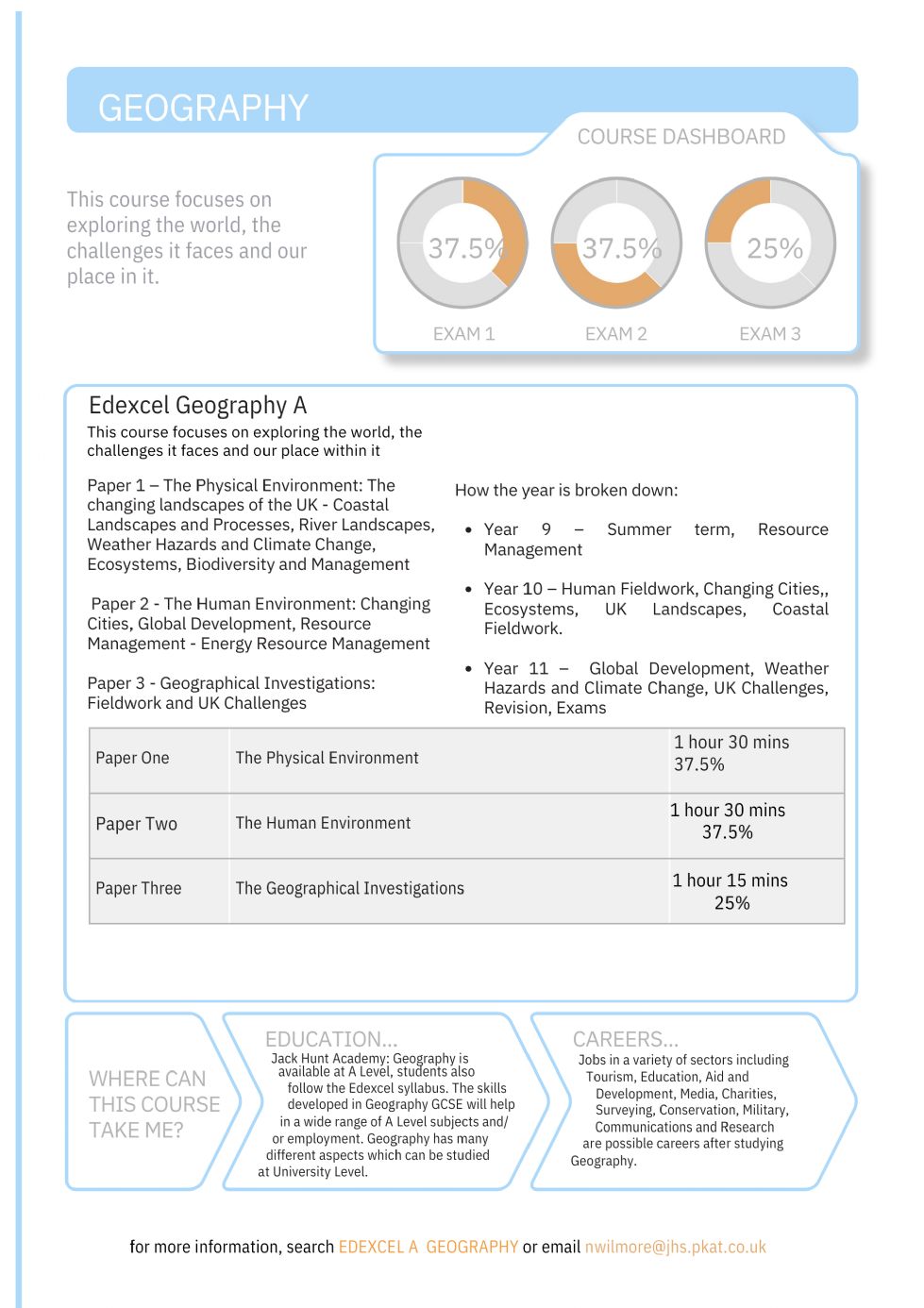
By the end of Key Stage 4 (GCSE Edexcel A), students will:
-
Build upon KS3 foundational knowledge by understanding in-depth content across physical and human topics including the UK's changing landscapes, urbanisation, development dynamics, and resource management.
-
Understand interdependencies at local, national and global scales, using case studies and contemporary examples.
-
Be able to apply and evaluate geographical skills, decision-making frameworks, and enquiry methods in unfamiliar contexts.
-
Use fieldwork evidence and data critically to draw conclusions and present reasoned arguments.
-
Engage in academic problem-solving, developing well-supported and balanced evaluative viewpoints.
-
Be equipped for ambitious next steps, including A Level study, apprenticeships or geography-related careers.
key stage 5
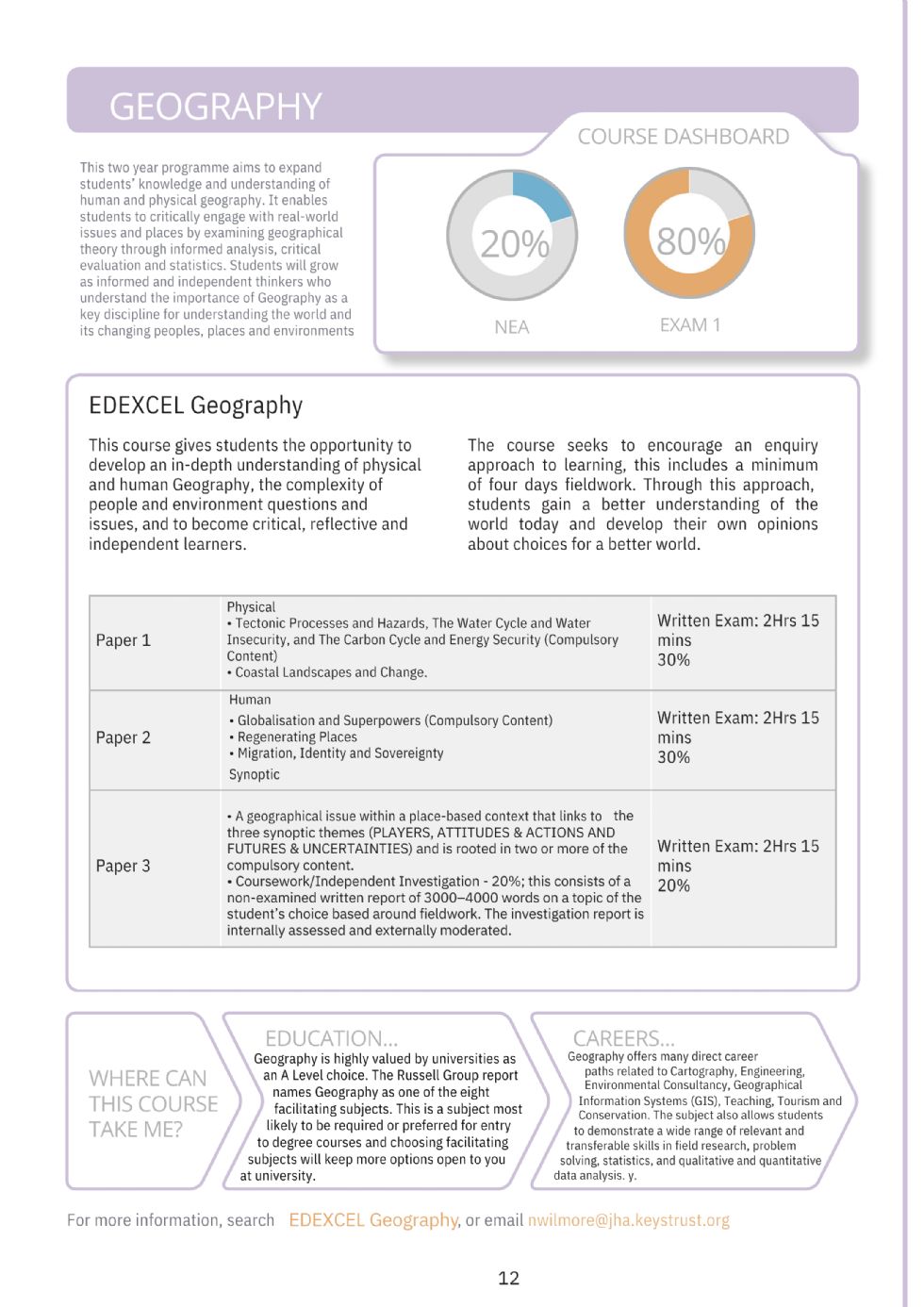
By the end of Key Stage 5 (A Level Edexcel A), students will:
-
Know complex geographical theories and frameworks across key areas including globalisation, water and carbon cycles, tectonics, regeneration, superpowers, and global development.
-
Understand and critically evaluate geographical models, data sources, and academic literature.
-
Be able to conduct independent investigation through the NEA, demonstrating advanced enquiry skills and methodological rigour.
-
Communicate complex ideas effectively through essays, debate and visual representation of data.
-
Be intellectually curious, reflective, and able to engage with real-world challenges such as climate change and inequality with a critical and ethical lens.
-
Be prepared for university-level study and to contribute meaningfully to society as informed global citizens.