


DRAMA
"All the world's a stage, and all the men and women merely players. They have their exits and their entrances; And one man in his time plays many parts." William Shakespeare
Rationale
The curriculum aims to produce confident, well-rounded learners of good character who will have developed life-long skills through their experience of drama at Jack Hunt Academy; relevant and transferable for any career path a student at Jack Hunt may wish to take. Our curriculum is child-centred, taking into consideration the diverse backgrounds of our learners and provides equal opportunities for all learners. Through the drama curriculum we develop high levels of knowledge and skill, which can lead to study at university level and beyond; Jack Hunt students could be the next generation of professionals working in the Creative Arts Sector.
Ambition
-
To develop a love of the arts and theatre so learners can contribute to their communities and become the critical audiences of the future in our local and national theatres.
-
To provide learners with new opportunities; a range of experiences in drama, physical and technical theatre, both in lessons and extra-curricular.
-
To work closely with local and national organisations to provide experiences for our learners to enrich their curriculum e.g. National Theatre Schools tour, theatre workshops and links with our local theatres.
-
To provide clear progression routes in Drama and Performing Arts, enabling pupils to take ambitious steps in this subject through to university and into careers in the creative industries
Key concepts, attributes and skills
-
Pupils will learn about a whole range of topics related to theatre; practitioners, styles of theatre, acting styles, stage design, lighting, costume, playwrights, devising, choreography, critical review
-
Through drama we will be developing the following life-long skills, relevant to any career path and not just the arts: creativity, leadership, teamwork, negotiation, confidence, communication, problem solving, curiosity, resilience, empathy, self-awareness, oracy, time management and organisational.
key stage 3
key stage 3 curriculum outline
• Students experience a wide range of topics designed to deepen their understanding of human interaction and to raise issues which are relevant and which students can explore to develop insight and informed opinions.
• Some of the topics which are covered include: Play scripts, Shakespeare, Commedia Dell’Arte, Physical Theatre, bullying, justice, live theatre and a variety of play texts to link with GCSE and A level study.
AIMS OF THE CURRICULUM AREA
• To enable students to develop a range of personal qualities such as perseverance, initiative, confidence, individual awareness and group sensitivity.
• To allow students to develop informed opinions and be able to support them by reasoned arguments free from prejudicial intolerance.
• To enable students to be familiar with a body of knowledge, principles, skills, techniques and vocabulary related to Drama and effective communication.
• To enable students to work independently and as part of a team in varied activities.
• To employ teaching methods and resources that allow all students to have equal access to Drama and to experience success and enjoyment in their work through their own efforts.
• To value each individual and so encourage each student to feel the value and worth of others. In doing so, to encourage empathy, so that each student approaches issues of race, gender and ability with tolerance and insight.
TEACHING METHODS
• Key Stage 3 - Staff employ a variety of practical and written activities during a lesson where students might be asked to work individually, in pairs, in small groups or as a class.
RESOURCES
The department has a Drama Studio equipped with stage lighting, audio/visual equipment and portable staging.
OTHER ACTIVITIES
Drama Club – Is offered every week as well as the opportunity to perform in school productions.
key stage 4
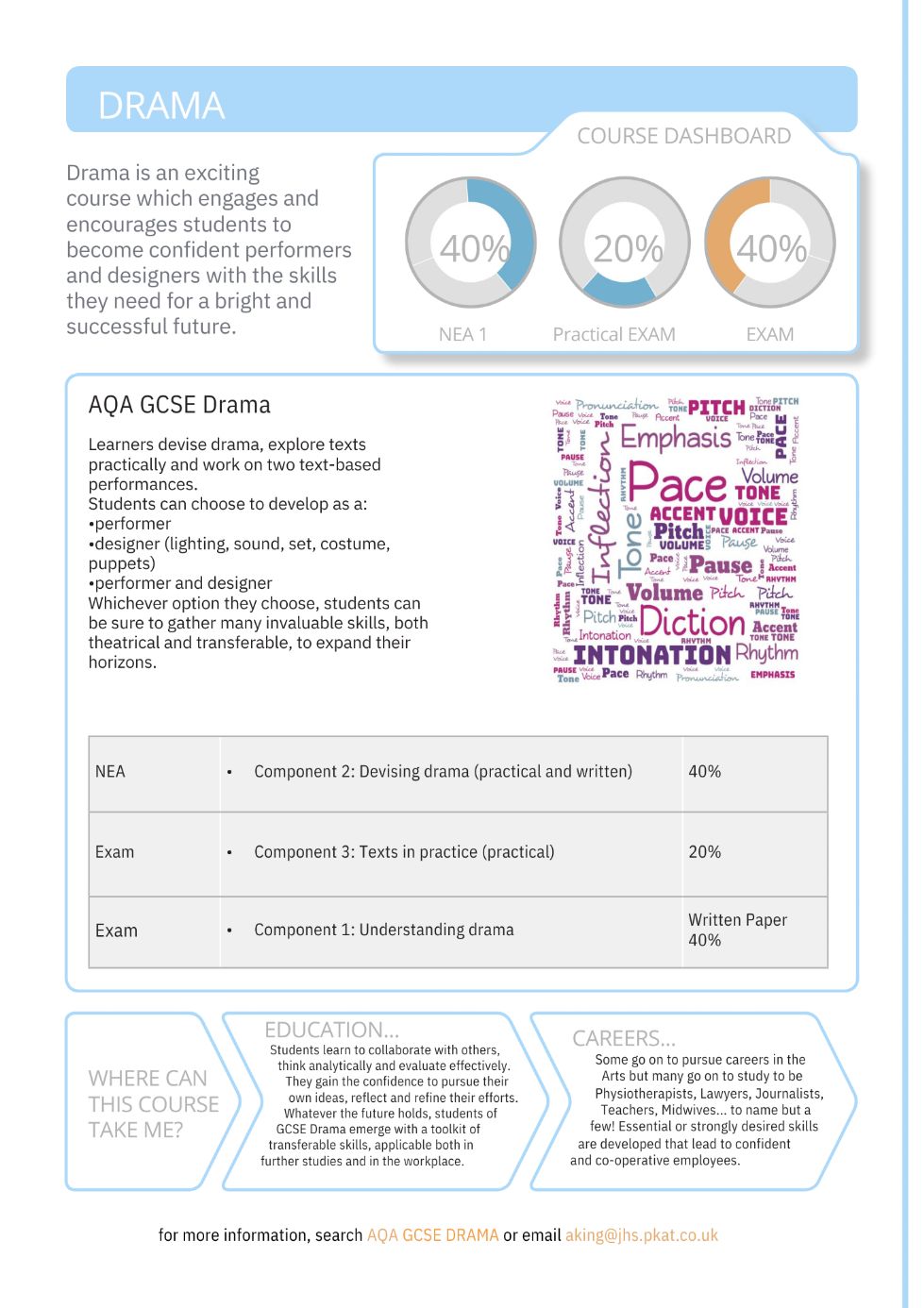
Students share ideas whilst working through six specific areas, including character and context, genre style and conventions and the semiotics of theatre.
Ambitions & outcomes
-
Lifelong skills: creativity, leadership, communication.
-
Reflective practitioners, confident performers, informed audiences.
-
Pathways to higher education and creative industries.